Social login in e-commerce: who uses it, which providers and why
What the published data says about social login: how often it is used, which providers win, how passkeys and in-app browsers change the picture, and what that means for a Magento store.
Social login lets a shopper create an account or sign in with an account they already have at Google, Apple, Facebook, Microsoft or another provider, instead of a new password. The best published platform data, from Okta and Auth0 and measured in March 2022 (still the latest of its kind), shows it used in about one login in seven, with Google far ahead of every other provider and Apple second on consumer sites.1 Shoppers like it because it removes passwords and forms; the ones who avoid it mostly worry about what data is shared.
This article collects the figures that exist, says who published them and who was asked, and is open about where good numbers are missing. Every figure is footnoted to its source, listed at the end.
What is social login?
Social login is a form of single sign-on. Your store sends the shopper to a provider such as Google; the shopper signs in there (often they already are) and approves the request; the provider sends your store a signed confirmation of who they are, usually with a name and an email address. Your store then creates the customer account or signs the existing customer in.
It runs on two open standards, OAuth 2.0 and OpenID Connect. The store never sees the shopper's password at the provider.
How many people use social login?
There is no recent, independent, e-commerce-specific survey that measures this well. What exists is platform data from identity vendors and a few consumer surveys, most of them published by companies that sell login products.
| Finding | Source and sample | Year |
|---|---|---|
| Social login was used in 14% of logins; 25% of monthly active users used it at least once. Username and password was still the most common method (62% of logins).1 | Okta and Auth0, anonymised login data across Auth0 customers worldwide (vendor data, all kinds of apps, not only shops) | Data March 2022, published 2023 |
| 34% of consumers said they are more likely to sign up when social login is offered; 31% of businesses offered it.2 | Auth0 and YouGov, online survey of more than 8,000 consumers in the UK, France, Germany, Australia, Singapore and Japan (vendor-commissioned) | 2021 |
| Over 55% of 18 to 25 year olds prefer social login; nearly 78% of over-50s prefer standard email registration.3 | LoginRadius, "2024 Consumer Digital Identity Trends Report", said to draw on 1.17 billion identities; no methodology published on the report page (vendor data) | 2024 |
| 66% of UK respondents said they use social sign-on (88% in the US).4 | Gigya survey by OnePoll, 2,000 UK and 2,000 US consumers (vendor-commissioned) | 2015, now old |
Read together: social login is a well-used minority option, not the default. Most people still sign in with an email address and password. The age pattern in the LoginRadius figures is plausible but cannot be checked, because the method is not published.
Is there newer platform data than March 2022? Not that we could find. We checked Okta's later reports. The Customer Identity Trends Report 2025 (a survey of 6,750 consumers in nine countries plus Auth0 platform data) reports on password reuse, sign-up attacks and attitudes to passkeys, but publishes no social login share or provider split.5 The Secure Sign-In Trends Report 2025 covers multi-factor authentication for workforce users,6 and Businesses at Work 2026 covers apps and AI adoption in companies.7 So the 2022 data is the latest published measurement of how often social login is used and which providers people choose. Treat it as a guide to the order of providers rather than an exact current share.
Which social login providers do shoppers choose?
The only large, published breakdown by provider comes from Okta and Auth0. It counts logins on their own platforms in March 2022, worldwide, across all kinds of apps.1 It is vendor data, but it is measured behaviour rather than a survey answer.
- Google 75%
- Apple 14%
- Facebook 7%
- Salesforce 1%
- GitHub 1%
| Provider | Share of social logins, Auth0 (all customer apps) | Share of social logins, Okta customer identity | Share of social logins, Okta workforce (staff and partners) |
|---|---|---|---|
| 75% | 73% | 82% | |
| Apple | 14% | 10% | under 1%8 |
| Microsoft | not in top five | 9% | 18% |
| 7% | 7% | under 1%8 | |
| GitHub | 1% | not in top five | not in top five |
| Salesforce | 1% | not in top five | not in top five |
| not in top five | under 1%8 | under 1%8 |
"Not in top five" means the report shows only the five most used providers for each platform and this one was not among them. "Under 1%" means the provider is in the top five but the report prints its share as 0%.
Three points from the same report matter for shops:1
- Google is offered almost everywhere. Fewer than 6% of Auth0 apps that offered social login and had monthly active social logins did not offer Google.
- Facebook and Apple are mainly consumer options. The report found Facebook Login and Sign in with Apple "mainly offered by consumer websites or apps".
- Audience decides the rest. B2B software favoured Salesforce, developer sites favoured GitHub, and in workforce settings Microsoft was the clear second.
X (formerly Twitter) and Amazon did not appear in the top five of any of the three groups. That does not mean nobody uses them; it means they are small next to Google, Apple, Microsoft and Facebook on these platforms.
Older figures often repeated online, such as "Facebook has 61% of social logins", come from Gigya network data for the last quarter of 2014, when Google+ still existed and Sign in with Apple did not.9 We would not rely on them today.
Does it differ by device, country or type of customer?
Device. We found no independent study that compares social login use on phones and computers. Two pieces of evidence point the same way. Pinterest reported to Google that after adding Google One Tap, new sign-ups rose 47% on web and mobile web and 126% on Android (a vendor-published case study with no baseline or period given).10 And phones are where typing an email address and a strong password is hardest. For UK stores, Apple matters on mobile: Statcounter recorded iOS on 46.88% of UK mobile page views in September 2026 (Android 53.11%), measured across sites that use its tracking code.11
Country. We found no recent public data that breaks social login use down by country for Europe. The Auth0 and YouGov survey covered the UK but published only combined consumer figures.2 Outside Europe, local providers matter more: Apple's own App Store rules list WeChat Login next to Facebook, Google, X, LinkedIn and Amazon as examples of login services.12
B2C or B2B. The Okta data is the clearest here.1 Consumer apps lean towards Google, Apple and Facebook; workforce and B2B settings lean towards Google and Microsoft, then LinkedIn and Salesforce. For a trade or wholesale Magento store, buyers often sign in from a work Microsoft 365 or Google Workspace account, which is why Microsoft and Google make sense before Facebook.
Why do shoppers prefer social login?
Shoppers rarely say "I want social login". What they say, in survey after survey, is that they dislike passwords and forms.
- Forgotten passwords cost sales. In the FIDO Alliance's 2024 Online Authentication Barometer (10,000 consumers in ten countries including the UK, fieldwork by Sapio Research in August 2024), 42% said they had abandoned a purchase at least once in the past month because they could not remember a password. That rose to 50% among 25 to 34 year olds and fell to 17% among over-65s. 56% had given up accessing an online service for the same reason.13 The FIDO Alliance promotes passkeys, so it has an interest in showing password pain.
- Long forms frustrate. Okta's Customer Identity Trends Report 2025 (6,750 consumers in nine countries) found that long sign-up or login forms frustrate 62% of users, that nearly a quarter abandon online purchases because of sign-up or login issues, and that 68% reuse passwords across accounts.5
- Account creation is a known abandonment reason. In Baymard Institute's survey of 1,026 US adults who had shopped online in the previous three months, 18% said they had abandoned an order because they did not want to create an account.14
Social login answers these problems for the shoppers who choose it: no form, nothing new to remember, and a quick way back in for returning customers already signed in at Google or Apple. Gigya's 2015 US survey, old and vendor-commissioned, gave the same reasons: avoiding forms (56%) and avoiding another password (43%).4
Why do some shoppers avoid social login?
The main reasons are privacy, habit and uncertainty about what is shared.
- Unclear data sharing. In a study of 424 participants at Carnegie Mellon University (Bauer et al., 2013), people's beliefs about what Google and Facebook passed to a site came from preconceptions rather than the consent screen, and many had strong concerns about data sharing.15 The study is old, but it is one of the few that tested real consent screens.
- Habit wins, until people see the permissions. In a 200-participant study by Morkonda, Chiasson and van Oorschot (Carleton University, 2023), usability and habit were among the dominant factors in which login option people chose. After seeing what each option shared, many switched to more privacy-friendly options.16
- Trust in the shop matters as much as the button. In Okta's Customer Identity Trends Report 2025, 74% said a company's reputation and trustworthiness was a priority when deciding whether to create an account, and 72% cared about security.5
- Practical worries. Okta and Auth0's 2023 whitepaper lists the downsides vendors see: people forget which provider they used, social networks are blocked in some workplaces and countries, and a compromised social account opens more doors.1
This is why social login works best as an extra option next to email sign-in and guest checkout, never as the only way in. Sign in with Apple's "Hide My Email" feature exists for exactly the privacy-minded shopper.1
Does social login increase registrations and conversion?
Honestly, the evidence is thin. We found no independent, controlled study that measures the effect of social login on e-commerce registration or checkout conversion. What exists:
- Provider case studies, such as Pinterest's figures for Google One Tap above.10 They are published by Google, report the best results and give no baseline period.
- Strong evidence that forced account creation and forgotten passwords lose orders (Baymard, FIDO Alliance, Okta).14135 Social login removes both problems for the shoppers who choose it, but no study we found isolates how many of those orders it wins back.
The sensible reading: social login is not a replacement for guest checkout. Baymard found that 62% of the sites it benchmarked fail to make guest checkout the most prominent option, and a hidden guest option loses orders whatever sign-in buttons sit beside it.14 Offer guest checkout clearly, and offer social login to the shoppers who want an account without the form. Then measure it in your own store.
Social login and passkeys in 2026
A passkey replaces a password with a cryptographic key pair stored on the shopper's phone or computer and unlocked with a fingerprint, face scan or PIN. Passkeys are based on FIDO Alliance and W3C standards and are tied to the site they were created for, so they cannot be used on a fake site; Apple syncs them across a person's devices through iCloud Keychain.17
Passkeys and social login do different jobs, so they complement each other rather than compete:
- Social login gives your store an identity from a provider and creates the account in one step. The shopper never sets a password at your store.
- A passkey replaces the password for one account, at your store or anywhere else. The account still has to exist first.
They also stack. Google and Apple accounts themselves support passkeys. Google made passkeys the default option for personal Google Accounts on 10 October 2023,18 and reported in May 2024 that they had been used more than 1 billion times across more than 400 million Google Accounts.19 Apple added passkey sign-in for Apple ID (now Apple Account) on its websites in June 2023, as reported at the launch.20 So a shopper can unlock their Google account with a passkey and then use "Sign in with Google" at your shop: passkey security at the provider, no password at your store.
Adoption at large services is real. The FIDO Alliance's Passkey Index (October 2025, an anonymised survey of nine member companies including Amazon, Google, Microsoft, PayPal and Target) found 93% of their accounts eligible for passkeys, 36% with a passkey enrolled and 26% of sign-ins using one.21 That is industry-body data from very large services, not from typical online shops.
For a Magento store: offer social login now; it works today and gives shoppers a password-free way in. Magento Open Source has no built-in passkey sign-in for customers (we checked the 2.4.9 core code), so passkeys on the storefront need a third-party extension or custom development. We do not sell a passkey module.
Pitfall: Google sign-in inside Instagram and Facebook
Many shoppers arrive from social media ads and posts. Instagram and Facebook usually open those links in their own built-in browser rather than in Safari or Chrome, and Google sign-in can fail there.
Google does not allow its sign-in page in embedded browsers ("webviews"). Its OAuth 2.0 policies say apps "must not direct a Google OAuth 2.0 authorization request to an embedded user-agent".22 Google announced on 29 June 2021 that all embedded webviews would be blocked from 30 September 2021, and warned web developers that if "a messaging or news application opens links to your site in an embedded webview", their Google sign-in may be affected.23 The shopper then sees Google's "Error 403: disallowed_useragent" page.24 Auth0's support article gives the same cause for users sent to a website from a third-party app that uses webviews,25 and developers have reported the error for links opened inside Instagram.26
Who is affected: shoppers who tap a link in Instagram, Facebook or a similar app and then choose "Sign in with Google" without leaving the app's browser. What you can do:
- Tell them how to get out. A short note near the buttons ("Signing in from Instagram or Facebook? Open this page in your browser first") helps, because Google's policy is aimed at embedded browsers, and its guidance for apps is to open links in the phone's normal browser instead.2224
- Keep other ways in. Email and password sign-in and guest checkout are not affected by Google's policy.
- Do not assume other providers fill the gap. Meta stopped supporting Facebook Login in Android embedded browsers on 5 October 2021.27 We found no official statement on whether Facebook Login or Sign in with Apple works inside Facebook's or Instagram's own in-app browser, so test each provider on a real phone before you rely on it.
Our Social Login module does not detect in-app browsers or show such a note by itself; you can add the note as text in a CMS block or in your theme.
What do UK and EU merchants need to know about privacy and GDPR?
This is not legal advice, but these points come up on every project:
- Collect only what you need. UK GDPR's data minimisation principle applies. For an account you need a name, an email address and a provider ID; ask the provider for nothing more.
- Tell customers. The ICO's guidance on the right to be informed says privacy information must cover your purposes, retention and who data is shared with.28 Name the sign-in providers you use in your privacy policy.
- Be careful with provider scripts. In the Fashion ID case (C-40/17, 2019), the EU Court of Justice held a website jointly responsible with Facebook for collecting and passing on visitor data through an embedded Like button.29 A social login that only contacts the provider when the shopper clicks avoids loading provider code on every page view.
- Meet each provider's own rules. Meta asks apps that access user data to provide a data deletion request URL or instructions.30 Apple requires you to register the domains you send email from before order emails reach customers who hid their address with Apple's relay.31
- Keep the stored data small. Store the link between customer and provider, not access tokens, and delete it with the customer.
What does this mean for a Magento store?
- Start with Google. Every data set we found puts it first by a wide margin.1
- Add Apple for consumer stores. It is the second consumer provider in the Okta data,1 and iPhones account for close to half of UK mobile page views.11
- Add Facebook if your customers use it. It sits behind Google and Apple in the Okta data.1 Look at your own audience before deciding.
- For B2B, add Microsoft and consider LinkedIn. Work accounts are Microsoft 365 or Google Workspace far more often than Facebook.
- Put the buttons where the decision happens: the sign-in page, the account creation page and the checkout sign-in, with guest checkout still easy to find.
- Link existing customers safely. Only connect a social identity to an existing account automatically when the provider has verified the email address and is responsible for it.
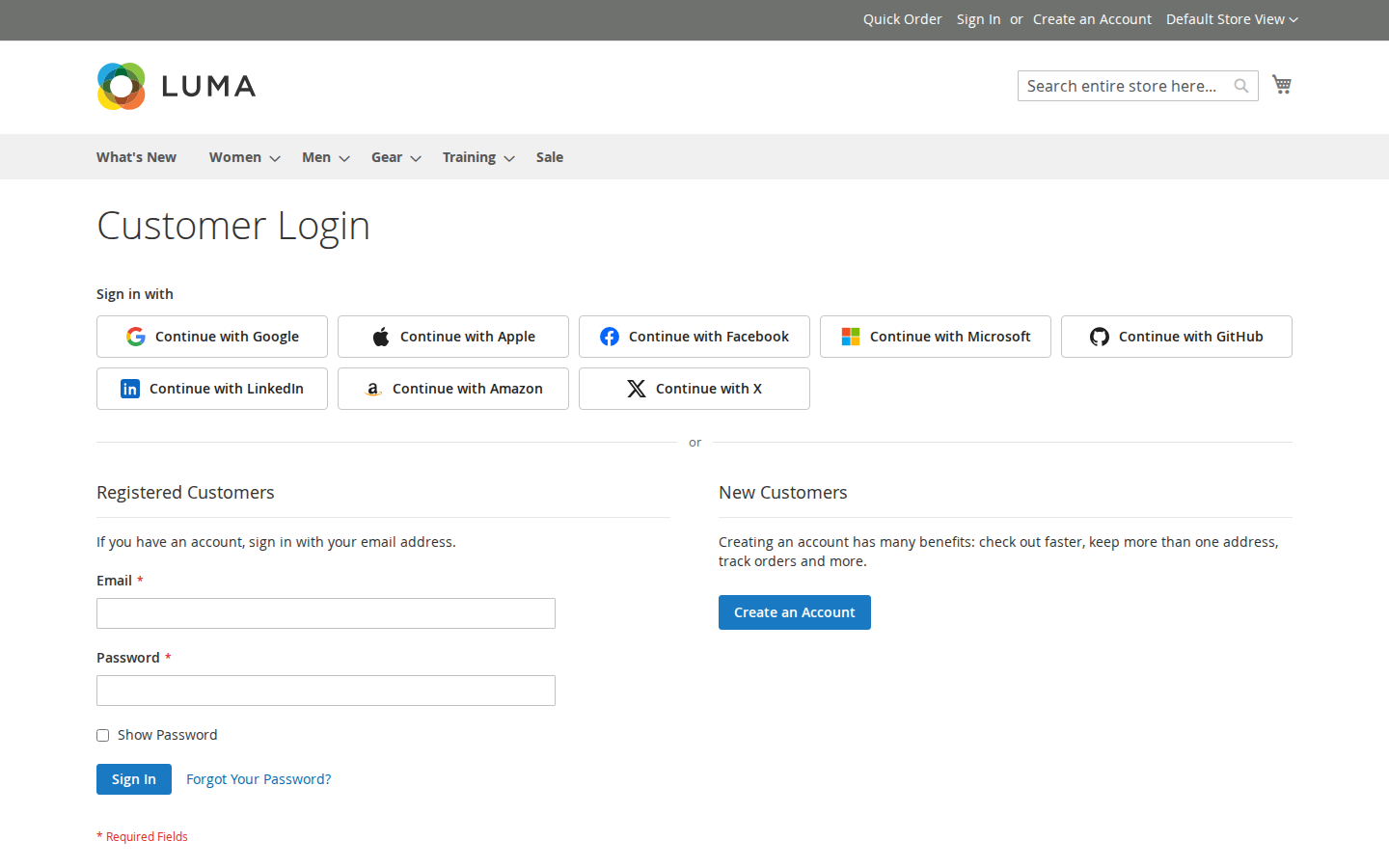
Our free Social Login for Magento 2 includes Google, by far the most used provider, plus Facebook and X; Apple (second on consumer sites), Microsoft, LinkedIn, Amazon and GitHub come with the Social Login Pro add-on, which requires the free module. The buttons work in Luma and Hyvä, load no provider scripts on your pages, and the admin shows how many sign-ins each linked account has had, so you can see which providers your customers actually use. Setting up each provider is covered step by step in how to get social login credentials for Magento 2.
Frequently asked questions
What percentage of people use social login?
No independent study gives a reliable figure for online shops. The largest published data, from Okta and Auth0 in March 2022, found social login in 14% of all logins on Auth0, with 25% of monthly active users using it at least once. Username and password was still used for 62% of logins.1 That is the latest published platform data we could find. Treat these as indicative, because they come from an identity vendor and cover all kinds of apps.
Which social login is the most popular?
Google, by a wide margin. In Okta and Auth0 data from March 2022, Google accounted for 75% of social logins on Auth0 and 73% on Okta's customer identity platform. Apple was second on consumer platforms with 10% to 14%, followed by Microsoft and Facebook. In workplace settings, Microsoft was second with 18%.1 Older figures that put Facebook first date from 2014 and 2015.9
Is social login better for conversion than guest checkout?
They solve different problems, so offer both. Guest checkout lets a shopper buy without any account; Baymard found that 18% of US online shoppers had abandoned an order because they did not want to create one.14 Social login helps shoppers who want an account but not a form or a new password. No independent study we found measures one against the other.
Do passkeys replace social login?
No. A passkey replaces the password for an account; social login creates the account and signs the shopper in through a provider. Google and Apple accounts support passkeys themselves,1820 so a shopper can use a passkey at Google and then sign in to your shop with Google. Magento has no built-in passkey sign-in for customers, so passkeys there need an extension or custom work.
Why does Google sign-in fail when shoppers come from Instagram?
Instagram and Facebook usually open links in their own built-in browser, and Google blocks its sign-in page in embedded browsers with "Error 403: disallowed_useragent".2324 Ask shoppers to open the page in their phone's browser, and keep email sign-in and guest checkout available.
Is social login GDPR compliant?
It can be, if you set it up with care. Request only the data you need, usually name and email address. Name the providers in your privacy policy, as the ICO's right to be informed guidance expects.28 Avoid loading provider scripts before the shopper clicks, store the provider link rather than access tokens, and delete it with the customer account. Meta and Apple add their own data rules.3031
Should a UK shop offer Sign in with Apple?
For most consumer stores, yes. Apple was the second most used social login on consumer platforms in the Okta and Auth0 data,1 and Statcounter recorded iOS on 46.88% of UK mobile page views in September 2026.11 Apple lets customers hide their email address, so you must register your sending domains with Apple for order emails to arrive.31
Which social logins suit B2B stores?
Google and Microsoft first, because most business buyers sign in with Google Workspace or Microsoft 365 accounts. In Okta's March 2022 workforce data, Google took 82% and Microsoft 18% of social logins.1 LinkedIn suits stores whose buyers live on it. For trade-only stores, allow social sign-in only for existing approved customers rather than creating new accounts automatically.
Why do some customers refuse to use social login?
Mainly privacy and habit. Studies by Carnegie Mellon University (2013) and Carleton University (2023) found that people are unsure what a provider shares, and many switch to a more private option once they see the permissions.1516 Others forget which provider they used,1 or prefer to keep shopping separate from social media. That is why email sign-in should stay available.
What to do next
Look at your own data before choosing providers: how many orders are guest orders, how many customers reset their password, how many sessions are on iPhones and how many visits come from Instagram or Facebook. Start with Google, add Apple for consumer stores and Microsoft for business buyers, keep guest checkout prominent, and review the sign-in counts per provider after a few months. If you want help setting it up on Magento or Hyvä, get in touch.
Sources
- Okta and Auth0, "Going deep with social login: a new analysis", whitepaper, data from March 2022, published June 2023. Anonymised, aggregated logins across Auth0 and Okta worldwide ("millions of users", "thousands of websites and apps"). Vendor data. https://www.okta.com/sites/default/files/2023-06/GoingDeepwithSocialLogin-Whitepaper-20230601-Final.pdf ↩1 ↩2 ↩3 ↩4 ↩5 ↩6 ↩7 ↩8 ↩9 ↩10 ↩11 ↩12 ↩13 ↩14 ↩15 ↩16
- Auth0, "Businesses Fall Short of Consumer Expectations for Login Experiences, Auth0 Survey Reveals", 2021. Auth0 and YouGov, more than 8,000 consumers in six markets, February to March 2021. Vendor-commissioned. https://auth0.com/blog/businesses-fall-short-of-consumer-expectations-for-login-experiences-auth0-survey-reveals/ ↩1 ↩2
- LoginRadius, "2024 Consumer Digital Identity Trends Report", 2024. Vendor data, methodology not published on the page. https://www.loginradius.com/resource/industryreport/2024-consumer-digital-identity-trends-report ↩
- MarTech, "Gigya Survey: 88% Of U.S. Consumers Say They Have Used Social Logins", 14 July 2015. Gigya and OnePoll, 2,000 US and 2,000 UK consumers, April 2015. Vendor-commissioned. https://martech.org/gigya-survey-88-of-u-s-consumers-say-they-have-used-social-logins/ ↩1 ↩2
- Okta, "Customer Identity Trends Report 2025: Securing customer trust in the age of AI", 24 June 2025. Survey of 6,750 consumers in nine countries plus anonymised Auth0 platform data; fieldwork agency and dates not stated. Vendor data. https://www.okta.com/newsroom/articles/customer-identity-trends-report-2025--securing-customer-trust-in/ ↩1 ↩2 ↩3 ↩4
- Okta, "The Secure Sign-In Trends Report 2025", press release (in Japanese), 10 December 2025. Anonymised workforce authentication data from Okta Workforce Identity to January 2025; covers multi-factor authentication, no social login figures. Vendor data. https://www.okta.com/ja-jp/newsroom/press-releases/secure-sign-in-trends-report-2025/ ↩
- Okta, "Businesses at Work 2026: Closing the identity gap in the age of AI", 30 April 2026. Okta platform data (1 November 2024 to 31 October 2025) and a survey of 261 executives; no social login figures. Vendor data. https://www.okta.com/newsroom/articles/businesses-at-work-2026/ ↩
- Note on "under 1%": the charts in source 1 (pages 7, 10 and 11) print whole percentages and show this provider at 0% of social logins, although it is among the top five listed and has some users or organisations (for example, LinkedIn appears in 4% of Okta customer identity organisations with social logins). The report does not say how it rounds, so we write "under 1%" rather than 0%. ↩1 ↩2 ↩3 ↩4
- TechCrunch, "Facebook Continues To Dominate Social Logins, Expands Lead To 61% Market Share", 27 January 2015. Gigya network data for the last quarter of 2014 (Facebook 61%, Google 22%). Vendor data, now old. https://techcrunch.com/2015/01/27/facebook-dominates-social-logins/ ↩1 ↩2
- Google for Developers, "Pinterest" case study for Google One Tap. Vendor-published, no period or baseline given. https://developers.google.com/identity/sign-in/case-studies/pinterest ↩1 ↩2
- Statcounter Global Stats, "Mobile Operating System Market Share United Kingdom", September 2026. Page views on sites using Statcounter, not people. https://gs.statcounter.com/os-market-share/mobile/united-kingdom ↩1 ↩2 ↩3
- Apple, "App Review Guidelines", guideline 4.8 Login Services, checked October 2026. https://developer.apple.com/app-store/review/guidelines/ ↩
- FIDO Alliance, "2024 Online Authentication Barometer", October 2024. 10,000 consumers in ten countries, Sapio Research, August 2024. Industry body that promotes passkeys. https://fidoalliance.org/wp-content/uploads/2024/10/Barometer-Report-2024-Oct-29.pdf ↩1 ↩2
- Baymard Institute, "Checkout UX: current state", updated November 2025. Survey of 1,026 US adults who shopped online in the previous three months; benchmark of checkout designs. https://baymard.com/blog/current-state-of-checkout-ux ↩1 ↩2 ↩3 ↩4
- Bauer, Bravo-Lillo, Fragkaki and Melicher, "A comparison of users' perceptions of and willingness to use Google, Facebook, and Google+ single-sign-on functionality", ACM DIM 2013. 424 participants. https://users.ece.cmu.edu/~lbauer/papers/2013/dim2013-sso.pdf ↩1 ↩2
- Morkonda, Chiasson and van Oorschot, "Influences of displaying permission-related information on web single sign-on login decisions", Computers & Security (preprint arXiv:2308.13074, 2023). 200 participants. https://arxiv.org/abs/2308.13074 ↩1 ↩2
- Apple Developer, "Passkeys", checked October 2026. https://developer.apple.com/passkeys/ ↩
- Google, "Passwordless by default: Make the switch to passkeys", The Keyword (Google blog), 10 October 2023. https://blog.google/technology/safety-security/passkeys-default-google-accounts/ ↩1 ↩2
- Google, "Passkeys, Cross-Account Protection and new ways we're protecting your accounts", The Keyword (Google blog), 2 May 2024. Google's own figures. https://blog.google/technology/safety-security/google-passkeys-update-april-2024/ ↩
- Six Colors (Dan Moren), "Apple adds passkeys to Apple ID, iCloud logins", 20 June 2023. Press report; we found no Apple support page that describes Apple Account passkey sign-in on the web. https://sixcolors.com/post/2023/06/apple-adds-passkeys-to-apple-id-icloud-logins/ ↩1 ↩2
- FIDO Alliance, "FIDO Alliance Launches Passkey Index, Revealing Significant Passkey Uptake and Business Benefits", 14 October 2025. Confidential survey of nine member organisations (Amazon, Google, LY Corporation, Mercari, Microsoft, NTT DOCOMO, PayPal, Target, TikTok) run with Liminal; averages across the nine. Industry body that promotes passkeys. https://fidoalliance.org/fido-alliance-launches-passkey-index/ ↩
- Google for Developers, "OAuth 2.0 Policies", section "Use secure browsers", last updated 5 August 2026. https://developers.google.com/identity/protocols/oauth2/policies ↩1 ↩2
- Google Developers Blog, "Upcoming security changes to Google's OAuth 2.0 authorization endpoint in embedded webviews", 29 June 2021. https://developers.googleblog.com/2021/06/upcoming-security-changes-to-googles-oauth-2.0-authorization-endpoint.html ↩1 ↩2
- Google for Developers, "Using OAuth 2.0 for Web Server Applications", error "disallowed_useragent", checked October 2026. https://developers.google.com/identity/protocols/oauth2/web-server ↩1 ↩2 ↩3
- Auth0 Support, "Error 403: disallowed_useragent when Using Google Sign In", updated 10 September 2025. Vendor knowledge base. https://support.auth0.com/center/s/article/disallowed-useragent-403-with-Google-sign-in ↩
- Discourse Meta forum, "Access Blocked Issue When Entering from Social Media", 26 February 2024. A user report of the error after opening a link inside Instagram, with an explanation from another forum member. Developer forum, not an official Google source. https://meta.discourse.org/t/access-blocked-issue-when-entering-from-social-media/296714 ↩
- Meta for Developers, "Deprecating support for FB Login authentication on Android embedded browsers", 28 June 2021, updated 27 August 2021 (cut-off 5 October 2021). https://developers.facebook.com/blog/post/2021/06/28/deprecating-support-fb-login-authentication-android-embedded-browsers/ ↩
- ICO, "The right to be informed", UK GDPR guidance, checked October 2026. https://ico.org.uk/for-organisations/uk-gdpr-guidance-and-resources/individual-rights/the-right-to-be-informed/ ↩1 ↩2
- Court of Justice of the European Union, Fashion ID GmbH & Co. KG v Verbraucherzentrale NRW eV, case C-40/17, judgment of 29 July 2019. https://curia.europa.eu/juris/liste.jsf?num=C-40/17 ↩
- Meta for Developers, "Data Deletion Callback", checked October 2026. https://developers.facebook.com/docs/development/create-an-app/app-dashboard/data-deletion-callback ↩1 ↩2
- Apple Developer, "Configure private email relay service", checked October 2026. https://developer.apple.com/help/account/capabilities/configure-private-email-relay-service/ ↩1 ↩2 ↩3
From our shop
Related Products
-
Social Login for Magento 2
One-click sign-in and registration with Google, Facebook and X — on the sign-in page, at checkout and anywhere you place the buttons.
- Magento 2.4.7 – 2.4.9
- Hyvä
- Luma
- Version v1.3.0
Free
-
Social Login Pro
Add Apple, Microsoft, LinkedIn, Amazon and GitHub sign-in to Softaware Social Login — same buttons, same settings, same account rules.
- Magento 2.4.7 – 2.4.9
- Hyvä
- Luma
- Version v1.0.0
From$149

